
 Oct 23, 2026
Creatine Capsules vs Powder vs Gummies: Which Form Is Best?
Every creatine format compared on dose, price and convenience, with real Australian prices.
By Roy Anderson, Founder of GUMO · Reviewed by Koji Wang, Physiotherapist · Last updated 23 October 2026
Creatine powder, creatine capsules, tablets and gummies all work the same way once the creatine reaches your muscles. The best form is the one you'll actually take every day at 3 to 5g: powder is the cheapest, capsules skip the taste, and gummies are the easiest to stick with.
Here's how each creatine format compares on dose, price, taste and convenience, using real Australian prices, so you can pick the one that suits you.
The short version
- All formats of creatine monohydrate work the same. The daily dose (3 to 5g) matters, not the format.
- Powder is by far the cheapest, at under $15 a month for 5g a day.
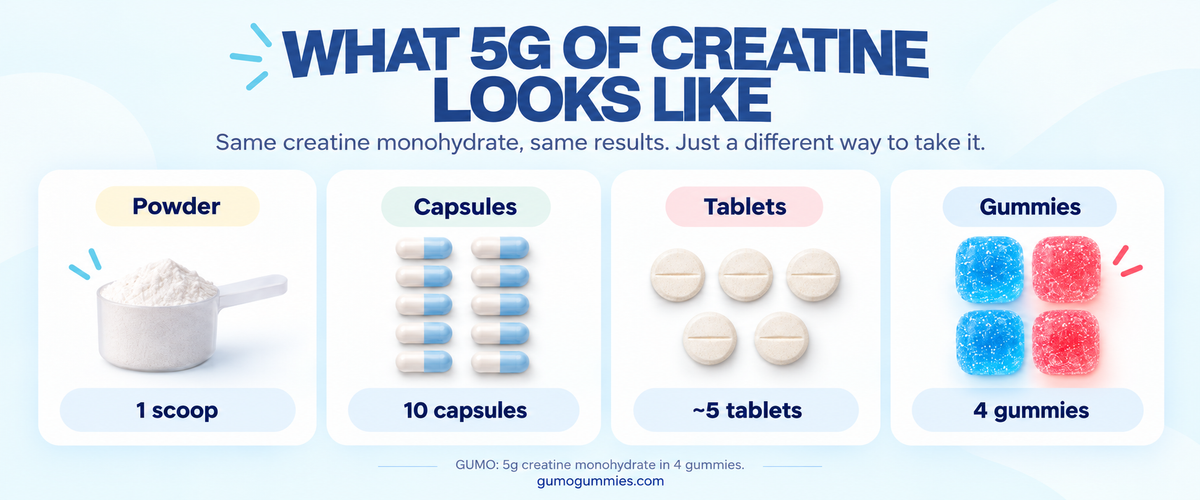
- Most creatine capsules contain 500mg, so a 5g dose means swallowing 10 capsules.
- Gummies are the easiest to take consistently, but only buy brands that publish batch lab results.
- Skip liquid creatine: creatine breaks down when it sits in liquid.
Creatine formats compared at a glance
| Format | Typical creatine per unit | How many for 5g | Price per 5g (AU) | Cost per month (5g a day) | Taste and texture | Best for |
|---|---|---|---|---|---|---|
| Powder | 5g per scoop | 1 scoop | Under $0.50 | Under $15 | Unflavoured, can be gritty; needs mixing | Lowest cost |
| Capsules / pills | 500mg per capsule | 10 capsules | About $1.25 to $2.50 | About $38 to $75 | No taste; lots to swallow | People who hate the taste of powder |
| Chewable tablets | About 1g per tablet | About 5 tablets | Varies widely | Varies | Chalky; some contain sugar | Occasional use on the go |
| Gummies | 1 to 1.25g per gummy | 4 to 5 gummies | About $1.30 to $2.30 | About $40 to $70 | Tastes like a lolly | Taking it consistently every day |
| Liquid | Varies | Varies | Not recommended | Not applicable | Creatine breaks down in liquid | Skip it |
Prices checked in October 2026: Bulk Nutrients creatine monohydrate powder ($24 to $48 a pouch), Musashi Creatine Capsules (500mg, about $15 to $30 per 120 capsules depending on the retailer and sales) and 30-serve packs of Australian creatine gummies (about $40 to $70). Price per 5g lets you compare formats with different serve sizes fairly.

Does the form of creatine matter?
No. Creatine monohydrate works the same whether it's in a powder, capsule, tablet or gummy, as long as you get the full daily dose.
Creatine doesn't work like caffeine, where you feel it within the hour. It works by slowly topping up the creatine stored in your muscles. A classic study by Hultman and colleagues found that taking 3g a day for 28 days raised muscle creatine to the same level as a 6-day, 20g-a-day loading phase. So whether a powder absorbs a few minutes faster than a capsule makes no real difference. What matters is the dose you take and whether you take it every day.
That's why the International Society of Sports Nutrition recommends 3 to 5g of creatine monohydrate daily, and why the Australian Institute of Sport lists creatine among its best-supported sports supplements. Neither says one format beats another, and that's true for women as much as men (more in creatine for women).
Creatine powder
Creatine powder is the cheapest and most flexible way to take creatine, at well under 50 cents per 5g for plain creatine monohydrate. It's the format used in most research, and you can adjust the dose to the gram.
Pros:
- The lowest price per gram by a long way.
- Easy to adjust your dose, including a loading phase if you want one.
- Mixes into shakes, smoothies or water.
Cons:
- Unflavoured creatine can taste chalky and doesn't fully dissolve in cold water, so it can feel gritty.
- You need a scoop, a drink and a few spare minutes, which makes it easy to skip on busy days.
- Harder to take when you're travelling.
I know the downside well. When I was on powder I kept forgetting it, and ended up with three or four unfinished tubs in the cupboard, some so old the powder had set hard. It suits you best if you already have a daily shake or smoothie routine.
Creatine capsules and pills
Creatine capsules and pills are pre-measured and tasteless, but most contain just 500mg each, so you need about 10 capsules to get 5g. That's the detail most comparison articles leave out.
Musashi Creatine Capsules, for example, contain 500mg of creatine monohydrate per capsule, with a recommended serve of 6 capsules (3g). A 120-capsule bottle works out to roughly $1.25 to $2.50 per 5g, depending on the retailer and whether it's on sale.
Pros:
- No taste, no mixing, no grit.
- Easy to carry and take anywhere.
- Exact dose every time.
Cons:
- Swallowing 6 to 10 capsules a day isn't pleasant for many people.
- Several times the price of powder per gram.
- Some capsule shells are made from gelatine, so check the label if you're vegan.
Best for: people who can't stand the taste or texture of powder and don't mind swallowing a handful of pills.
Creatine tablets and chews
Creatine tablets are usually chewable and contain around 1g of creatine each, so a 5g dose takes about 5 tablets. They sit between capsules and gummies: you chew them rather than swallow them, but they're firmer and chalkier than a gummy.
Check the nutrition panel before you buy. Some chewable creatine tablets use dextrose as a sweetener. MyProtein's Creapure chewable tablets, for example, list 5.3g of sugar per 3-tablet serve.
They don't need water and they're easy to carry, but they can be chalky, some contain sugar, and prices vary a lot between brands.
Best for: people who want something chewable but don't like gummies.
Creatine gummies
Creatine gummies are the easiest format to take consistently, with the best products giving you 5g of creatine in 4 gummies that taste like lollies. For a lot of people, that's the difference between taking creatine every day and giving up after two weeks.
Pros:
- They taste good, so it's easy to build a daily habit.
- No water, scoop or swallowing pills.
- Easy to keep in your bag, desk or car.
Cons:
- More expensive per gram than powder (though similar to capsules).
- Quality varies. Creatine can break down during gummy manufacturing, and in 2024, NOW Foods lab-tested 12 creatine gummy brands and found 5 contained little to no creatine.
- Some brands only put 1g in each gummy, so you'd need 5 or more for a full dose.
- Heat makes them stick together. I once left a bag in a hot car; they separated again once the bag was somewhere cool and I shook it.
If you go the gummy route, choose a brand that publishes batch lab results. Our creatine gummies give you 5g of creatine monohydrate in 4 gummies, with no sugar, and every batch is third-party lab tested in Australia with the results published. I started GUMO because so many creatine gummies had little or no creatine inside, and I wanted one I could actually trust.
Best for: anyone who has tried powder or capsules and struggled to stick with it, or who simply wants creatine to be the easiest part of their day.
What about liquid creatine?
Skip liquid creatine. Creatine is unstable in water and gradually breaks down into creatinine, a waste product your body can't use. The ISSN notes that after three days at 25°C, up to 21% can turn into creatinine in acidic conditions, which is why pre-made liquid creatine products have a poor track record. A 2011 review by Jäger and colleagues found no evidence that liquid or other novel forms work better than plain creatine monohydrate.
Mixing powder into a drink and having it straight away is fine. The problem is creatine sitting in liquid for days or weeks on a shelf.
Which creatine format is best for you?
Pick based on what's most likely to stop you taking it:
- If price matters most, go with plain creatine monohydrate powder.
- If you hate the taste or texture of powder, try gummies, or capsules if you don't mind swallowing pills.
- If you keep forgetting to take it, gummies are the easiest to turn into a habit, because you'll actually look forward to them.
- If you travel a lot, go for gummies or capsules, since there's nothing to mix or measure.
- If you want to do a loading phase, use powder, because 20g a day means 40 capsules or around 16 gummies. Loading is also the main cause of stomach upset (see creatine side effects).
What to check, whatever format you choose
- Creatine monohydrate. It's the form behind almost all the research (what is creatine monohydrate?). "Pure creatine" usually just means creatine monohydrate with nothing added.
- Creatine per serve, not per unit. Work out how many capsules, tablets or gummies you need to reach 3 to 5g.
- Independent testing. Look for published batch lab results, or HASTA or Informed Sport certification if you're drug tested. This matters most for gummies.
- Price per 5g. Divide the price by the total grams of creatine in the pack, then multiply by 5.
A note on bias: GUMO makes creatine gummies, so we have an interest here. That's why this guide shows the real price gap with powder, and links every claim to its source.
Try GUMO Creatine Gummies. 5g of creatine monohydrate in 4 gummies, no sugar, and every batch lab tested in Australia. Rated 4.9 stars from 500+ reviews.
Frequently asked questions
Is creatine best taken in powder or capsules?
Neither is better for results. Powder and capsules both deliver creatine monohydrate, which works by building up in your muscles over time. Powder is much cheaper; capsules are more convenient and tasteless. Choose the one you'll take every day.
Are creatine pills as good as powder?
Yes, creatine pills work as well as powder if you take the same daily dose. Most pills contain 500mg of creatine, so you need about 10 to match a 5g scoop of powder.
Are creatine tablets as good as powder?
Yes, creatine tablets work as well as powder at the same daily dose. Most chewable tablets contain about 1g of creatine, so you need around 5 for 5g. Check the label for added sugar.
How many creatine capsules equal 5g?
With standard 500mg capsules, 10 capsules equal 5g of creatine. Check your label, since some capsules contain 750mg or more, which would mean fewer capsules.
Are creatine gummies as effective as powder?
Creatine gummies are as effective as powder when they contain the creatine stated on the label. Choose a brand that publishes batch lab results, since independent testing has found some gummies are underdosed. Read more in creatine gummies vs powder.
Which form of creatine is the cheapest?
Plain creatine monohydrate powder is the cheapest form of creatine in Australia, at well under 50 cents per 5g serve. Capsules and gummies typically cost about $1.25 to $2.50 per 5g.
What is the best form of creatine?
Creatine monohydrate is the best form of creatine, because it's the most researched and proven. Our guide to creatine HCl vs monohydrate explains why it beats the most popular alternative. The best format (powder, capsule or gummy) is whichever one you'll take consistently at 3 to 5g a day.
We keep this guide up to date
3 October 2026: guide published with current Australian prices.
23 October 2026: prices re-checked and formatting updated. Reviewed by Koji Wang.
Sources
- Kreider et al. (2017), International Society of Sports Nutrition position stand: safety and efficacy of creatine supplementation
- Hultman E. et al. (1996). Muscle creatine loading in men. Journal of Applied Physiology, 81(1), 232 to 237
- Jäger R. et al. (2011). Analysis of the efficacy, safety, and regulatory status of novel forms of creatine. Amino Acids
- Australian Institute of Sport: Sports Supplement Framework
- SupplySide Supplement Journal: NOW tests creatine gummies (2024)
- Bulk Nutrients Creatine Monohydrate (price reference)
- Musashi Creatine Capsules (price and dose reference)
- MyProtein Creapure Chewable Creatine Tablets (sugar reference)
About the author
Roy Anderson is the founder of GUMO and has taken creatine daily for over three years. He started GUMO after seeing brand after brand sell creatine gummies with little or no creatine inside. Every batch of GUMO Creatine Gummies is third party lab tested in Australia, with the results published. Read more about Roy →
Related Articles
Oct 23, 2026
 Oct 23, 2026
 Oct 23, 2026

Try GUMO Risk-Free for 30 Days.
Experience the difference with complete confidence. If you're not satisfied within 30 days, we'll refund your purchase - no questions asked.
- 30-Day Money-Back Guarantee
- Fast Shipping
- Premium Ingredients
- Trusted by Thousands