
 Oct 23, 2026
How Much Creatine Per Day? Dose by Body Weight
The right daily creatine dose for your body weight, whether to load, and what to do if you miss a day.
By Roy Anderson, Founder of GUMO · Reviewed by Koji Wang, Physiotherapist · Last updated 23 October 2026
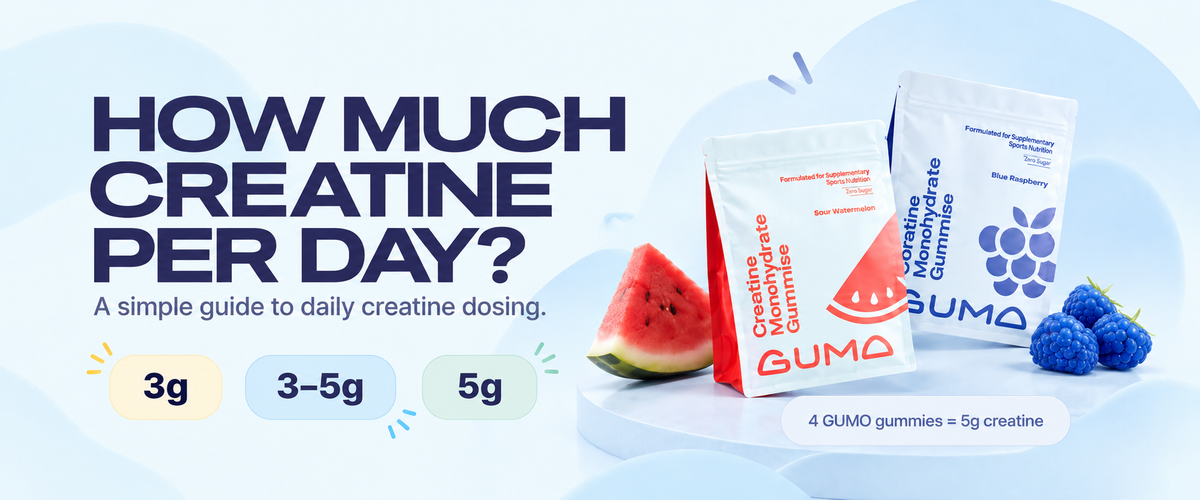
Most adults should take 3 to 5g of creatine monohydrate per day. That's the dose recommended by the Australian Institute of Sport and the International Society of Sports Nutrition, and it fully tops up your muscles' creatine stores in about four weeks. Take it every day, including rest days.
Below you'll find the exact dose for your body weight, whether you need a loading phase, what to do if you miss a day, and how many capsules or gummies that works out to.
The short version
- The standard dose is 3 to 5g of creatine monohydrate per day, for men and women alike.
- Larger, more muscular people (around 90kg and up) should aim for 5g, and very muscular athletes may need up to 10g.
- A loading phase (about 20g a day for 5 days) is optional. It gets you to full stores faster, not further.
- Take creatine every day, including rest days. Timing matters much less than consistency.
- For most people, more than 5g a day doesn't give better results; your body just gets rid of the extra.
How much creatine should I take per day?
Take 3 to 5g of creatine monohydrate per day. That's enough to raise your muscle creatine stores to their maximum over about four weeks, and to keep them there.
This comes straight from the research. The Australian Institute of Sport recommends a maintenance dose of "about 3 to 5 g/d", and the International Society of Sports Nutrition gives the same range. A classic study by Hultman and colleagues found that just 3g a day for 28 days raised muscle creatine by about 20%, the same as a high-dose loading phase.
Creatine works by building up in your muscles over time, not by giving you a hit on the day you take it. That's why the daily habit matters more than the exact gram. If you're new to creatine, what is creatine explains how it works.
Creatine dosage by body weight
The AIS body-weight formula is 0.3g per kg per day if you're loading, then 3 to 5g a day to maintain. Here's what that looks like for common body weights:
| Body weight | Daily dose (no loading) | Optional loading dose (5 days) |
|---|---|---|
| 50kg | 3g | 15g a day |
| 60kg | 3 to 5g | 18g a day |
| 70kg | 3 to 5g | 21g a day |
| 80kg | 3 to 5g | 24g a day |
| 90kg | 5g | 27g a day |
| 100kg+ | 5g (up to 10g for very muscular athletes) | 30g a day |
Loading doses use the AIS guideline of 0.3g per kg of body weight per day, split into 3 to 4 doses with meals. Daily doses use the AIS and ISSN maintenance range of 3 to 5g.

Why not just use a formula for the daily dose too? The AIS maintenance formula (0.03g per kg) gives about 2 to 3g for most people, which sits at the bottom of the proven range. Rounding up to 3 to 5g is simpler and keeps you comfortably where the research says creatine works.
Is 5g of creatine a day better than 3g?
For most people, 3g and 5g a day end up in the same place: full muscle creatine stores. The difference is mostly about body size. More muscle means more storage space, so if you're larger or very muscular, 5g is the safer bet, and the ISSN notes that some larger athletes may need as much as 5 to 10g a day to keep their stores full. If you're smaller, 3g is enough.
5g is also the dose used in most studies and the easiest to measure: one level scoop of powder, or one serve of most creatine gummies. If you're unsure, 5g is a sensible default.
Can you take too much creatine?
For most people, taking more than about 5g a day won't build bigger stores; once your muscles are full, your body breaks down the extra and you pass it in your urine. The exception is very large, muscular athletes, who may need up to 10g. High single doses (10g or more at once) are also the most common cause of creatine's main side effect, an upset stomach or bloating. See creatine side effects for more.
Some research is looking at higher doses for brain health, but it's early and not something to try on your own. For muscle and strength, 3 to 5g is all you need.
Do you need a creatine loading phase?
No. A loading phase is optional: it fills your muscles with creatine in about a week instead of about four weeks, but you end up in exactly the same place.
- With loading, you take about 20g a day (or 0.3g per kg), split into four doses, for 5 to 7 days, then drop to 3 to 5g a day.
- Without loading, you take 3 to 5g a day from day one and reach full stores in about four weeks.
Loading makes sense if you have a competition coming up and want the benefits quickly. For everyone else, skipping it is simpler and easier on your stomach. I tried loading once and mostly remember drinking far more water than usual and being up and down to the toilet all day, which is a big part of why I stick to 5g a day now. Our guide to the creatine loading phase covers it in detail.
Should women take less creatine than men?
No. Women should take the same 3 to 5g a day as men. You might see advice suggesting 3 to 4g for women, but creatine dosing is based on body weight and muscle mass, not sex. A 60kg woman and a 60kg man need the same amount. Read more in creatine for women.
How many capsules, scoops or gummies is that?
5g of creatine is one level scoop of powder, about 10 standard capsules, or 4 GUMO gummies. Always check the creatine per serve on your label, not the size of the product:
- Most scoops of powdered creatine monohydrate are 5g. Check yours, as some are 3g.
- Capsules are usually 500mg each, so 6 capsules for 3g or 10 for 5g.
- Gummies vary by brand, often 1g to 1.5g each. Our GUMO creatine gummies contain 5g in 4 gummies. See creatine gummies vs powder for how the two compare.
- Many pre-workouts contain creatine, but often less than 3g per serve. Don't count on a pre-workout alone to cover your daily dose.
For a full side-by-side, see creatine powder vs capsules vs gummies.
Do you take creatine on rest days?
Yes. Take creatine every day, including rest days. Your muscles use and break down a small amount of creatine every day whether you train or not, so daily intake keeps your stores topped up. The timing on rest days doesn't matter; just take it when it suits you.
What if you miss a day of creatine?
If you miss a day, just take your normal dose the next day. Don't double up. Your muscle stores drop very slowly, so one missed day makes no real difference.
Missing weeks is a different story. In the Hultman study, people's muscle creatine was back to where it started 30 days after they stopped. The best dose is the one you'll actually take every day, which is why it helps to tie creatine to something you already do, like breakfast or your morning coffee. Mine is four GUMO gummies with my morning coffee, every day.
When should you take creatine?
Take creatine whenever you'll remember it every day; the timing matters far less than the daily dose. The AIS notes that creatine is absorbed a little better with a meal containing carbohydrate and protein, so taking it with breakfast or after training is a good habit. Our guide on when to take creatine goes into more detail.
How much creatine do you get from food?
Your body makes most of its own creatine, and a diet with meat and fish supplies the rest, but food alone won't fill your muscle stores. A 2026 paper by Ostojic in Nutrition Reviews estimated that the body makes about 73% of the creatine it needs each day, with the rest coming from food.
Supplements take you well beyond that baseline, which is how creatine improves strength and performance. Vegetarians and vegans get very little creatine from food, so they tend to have lower muscle creatine stores and may see bigger gains from supplementing. See is creatine vegan?
Who should check with a doctor before taking creatine?
Creatine is safe for most healthy adults, but check with your GP first if you have kidney disease, are pregnant or breastfeeding, are under 18, or take medication that affects your kidneys. Creatine can also raise creatinine on a blood test, a normal effect of supplementing that can be mistaken for a kidney problem, so let your doctor know you take it. More in who should avoid creatine.
A note on bias: GUMO makes creatine gummies, so we have an interest here. The dosing advice in this guide comes from the AIS and ISSN, and applies whatever form of creatine you take.
The full 5g, no measuring. Four GUMO Creatine Gummies give you 5g of creatine monohydrate, with no sugar, and every batch is lab tested in Australia. Rated 4.9 stars from 500+ reviews.
Frequently asked questions
Is 5g of creatine a day too much?
No. 5g of creatine a day is the standard dose used in research and recommended by the AIS for long-term daily use. It's safe for healthy adults and is the upper end of the 3 to 5g range.
Is 3g of creatine a day enough?
Yes. 3g of creatine a day is enough for most people to fully top up their muscle stores within about four weeks. Larger or very muscular people may do better with 5g.
Can I take 10g of creatine a day?
Most people get no extra benefit from 10g a day, because once muscle stores are full the excess is excreted. Very large, muscular athletes are the exception: the ISSN says they may need 5 to 10g a day. If you do take more, split it into smaller doses, since large single doses are more likely to upset your stomach.
How much creatine per kg of body weight?
The AIS guideline is 0.3g per kg of body weight per day for a 5-day loading phase, then about 0.03g per kg per day (or simply 3 to 5g) to maintain. Without loading, 3 to 5g a day works for most adults.
How many creatine gummies should I take a day?
Take as many gummies as it takes to reach 3 to 5g of creatine, which depends on the brand. With GUMO, 4 gummies give you 5g. Check the creatine per gummy on your label.
Do you need to drink more water when taking creatine?
You don't need to drink lots of extra water, but staying well hydrated is sensible, especially in hot weather or when training hard. Creatine draws a little water into your muscles, which is normal and part of how it works.
How long should you take creatine for?
You can take creatine long term. Studies of up to five years in healthy people have consistently found no harmful effects. Benefits last only while your muscle stores stay topped up, so it works best as an ongoing daily habit.
We keep this guide up to date
5 October 2026: guide published. Dosing reviewed against AIS and ISSN guidance.
23 October 2026: formatting updated. Reviewed by Koji Wang.
Sources
- Australian Institute of Sport: Creatine, how and when do I use it?
- Kreider et al. (2017), International Society of Sports Nutrition position stand: safety and efficacy of creatine supplementation
- Hultman E. et al. (1996). Muscle creatine loading in men. Journal of Applied Physiology, 81(1), 232 to 237
- Ostojic S.M. (2026). Establishing Dietary Reference Intakes for Creatine in Adults. Nutrition Reviews
About the author
Roy Anderson is the founder of GUMO and has taken creatine daily for over three years. He started GUMO after seeing brand after brand sell creatine gummies with little or no creatine inside. Every batch of GUMO Creatine Gummies is third party lab tested in Australia, with the results published. Read more about Roy →
Related Articles
Oct 23, 2026
 Oct 23, 2026
 Oct 23, 2026

Try GUMO Risk-Free for 30 Days.
Experience the difference with complete confidence. If you're not satisfied within 30 days, we'll refund your purchase - no questions asked.
- 30-Day Money-Back Guarantee
- Fast Shipping
- Premium Ingredients
- Trusted by Thousands