
 Oct 23, 2026
What Is Creatine? What It Does, Benefits and How to Take It
What creatine is, how it works, which benefits are proven, and how to take it, explained in plain English.
By Roy Anderson, Founder of GUMO · Reviewed by Koji Wang, Physiotherapist · Last updated 23 October 2026
Creatine is a natural compound your body makes from amino acids and stores mostly in your muscles, where it helps produce energy for short, intense efforts. As a supplement, it's one of the best researched in the world. The best-proven creatine benefits are more strength, muscle and power, when you take 3 to 5g a day alongside training.
That's the simple version. The longer version is more interesting, and a lot more honest than most of what you'll find online. Creatine's benefits for strength and muscle are rock solid. Some of the other claims, like fixing brain fog or helping with Parkinson's, are either early or don't hold up. This guide covers what creatine is, how it works, which benefits are proven, and how to take it.
The short version
- Creatine is made mainly in your liver and kidneys from three amino acids. About 95% of it is stored in your muscles.
- It helps your muscles quickly regenerate ATP, the energy they burn in short, hard efforts.
- The proven benefits are more strength, power and muscle, when combined with training.
- Brain function, mood and healthy ageing beyond muscle are promising but early.
- Without exercise, it does little for strength or performance.
- The standard dose is 3 to 5g of creatine monohydrate a day, and it's safe for healthy adults.
What is creatine?
Creatine is a compound made from three amino acids: arginine, glycine and methionine. You'll often see it called an amino acid, but as Harvard Health points out, it isn't technically one of the 20 amino acids that make up proteins. Your body builds it from them.
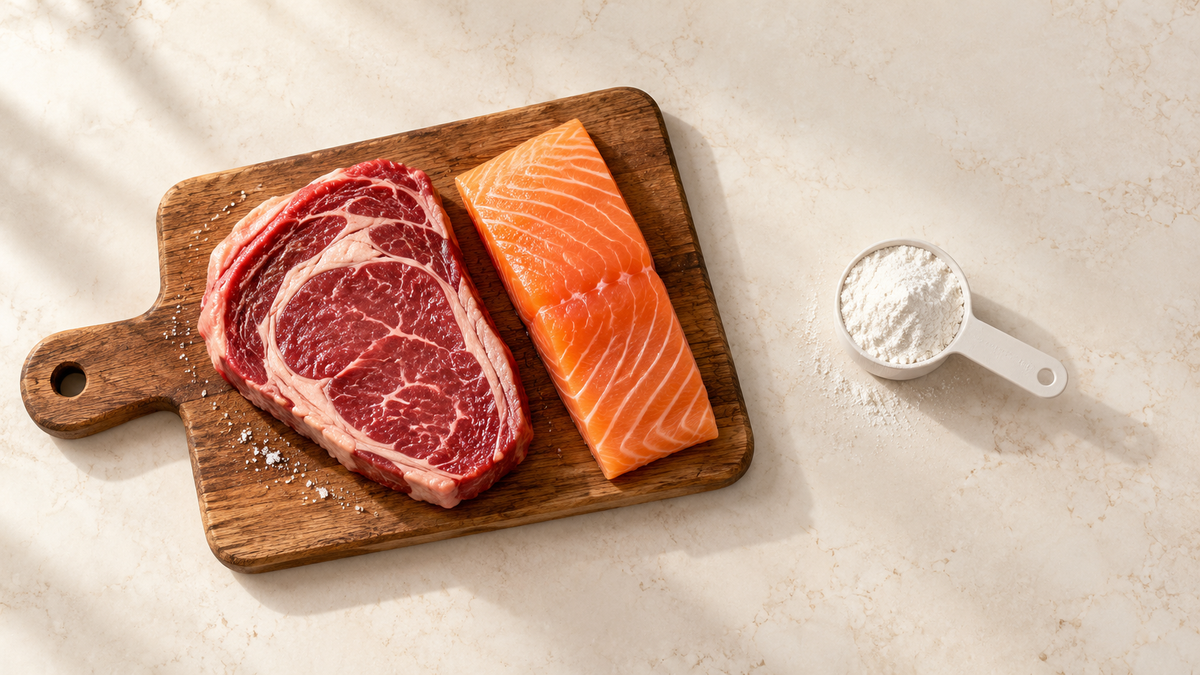
Your body makes about 1g of creatine a day, and you get roughly another 1g from food, mainly red meat and seafood, according to the Australian Institute of Sport. Most of it is made in the liver and kidneys, and about 95% ends up in your skeletal muscles, according to the ISSN. The rest is spread around your brain and other tissues.
Your body breaks down about 1 to 2% of its creatine every day and gets rid of it as a waste product called creatinine. That's why you need a steady supply, either from your own production, your diet, or a supplement.
A short history of creatine
Creatine isn't a new fad. A French chemist, Michel Eugène Chevreul, first identified it in 1832 in meat extract, and named it after the Greek word for meat, kreas.
It hit the mainstream around the 1992 Barcelona Olympics, when British sprinters including gold medallist Linford Christie reportedly used it in training. Creatine supplements went on commercial sale the following year. More than three decades on, there are over 500 peer reviewed publications on creatine supplementation.
How does creatine work?
Creatine helps your muscles rebuild their main energy molecule, ATP, very quickly during short, hard efforts.
Your muscles run on ATP (adenosine triphosphate). The problem is they only hold enough for a few seconds of all-out effort. So your muscles store creatine as phosphocreatine, which can donate energy to rebuild ATP on the spot. That's what keeps you going through a heavy set, a sprint or a burst of effort in sport.
When you supplement, you top up those phosphocreatine stores. A classic study by Hultman and colleagues found that supplementing raised muscle creatine by about 20%. More fuel in the tank means you can squeeze out an extra rep or two before you fatigue. Over weeks and months of training, those extra reps add up to more strength and muscle.

What does creatine do?
In plain English: creatine lets you train a bit harder, and harder training gets better results. It doesn't build muscle on its own. Harvard Health is blunt about it: creatine supplementation does not build muscle. What it does is help you get more out of resistance training.
Creatine also draws water into your muscle cells. That's why some people notice the scales tick up slightly when they start. It's water inside the muscle, not fat, and it may play a small part in how creatine supports muscle growth.
The research on brain function is a newer area. Your brain uses creatine too, and scientists are studying whether supplementing helps memory or mental fatigue. It's interesting, but it's early, and I'll cover it honestly below.
Creatine benefits: what the evidence actually says
Not all the benefits of creatine are equal. Some are backed by hundreds of studies. Others are based on a handful of small trials, or don't hold up at all. Here they are, ranked by the strength of the evidence.
| Benefit | Strength of evidence | What the research shows |
|---|---|---|
| Strength and power | Strong | Improves performance in short, high intensity efforts, typically by around 5 to 15%. |
| Muscle mass | Strong | Greater gains in lean muscle when combined with resistance training. |
| Repeated sprints and team sports | Strong | Helps you recover between repeated bursts of effort. |
| Strength in older adults | Moderate | Helps maintain strength and muscle with resistance training as you age. |
| Recovery | Moderate | Some evidence it helps muscles recover after hard training. |
| Brain function and mood | Early | Promising small studies, especially under sleep deprivation, but not established. |
| Bone health | Mixed | Some studies show benefits with resistance training; others don't. |
| Parkinson's, ALS | Not supported | Reviews found no reliable benefit. |

Strength and power
This is creatine's best known benefit, and the best proven. Across many studies, creatine has been shown to improve maximum power and performance in high intensity, repeated efforts by around 5 to 15%, according to a review by Richard Kreider. That's why the AIS lists creatine as a Group A supplement, its category for supplements with the strongest scientific support.
Muscle mass
Combined with resistance training, creatine leads to greater gains in lean muscle than training alone. Part of that is extra water in the muscle early on, but over time it reflects real muscle built from more productive training. The International Society of Sports Nutrition calls creatine monohydrate the most effective nutritional supplement available for increasing high intensity exercise capacity and lean body mass.
Healthy ageing and staying strong after 50
From middle age, we slowly lose muscle and strength, a process called sarcopenia. Creatine combined with resistance training can help slow it. Mayo Clinic notes older adults who take creatine and do resistance exercise can improve their strength, and a 2022 review by Darren Candow and colleagues concluded creatine plus resistance training has potential to help with muscle and function in older adults. For women going through menopause, see creatine for women and creatine and menopause.
"With my patients over 45 who take creatine, one of the biggest things they're focused on right now is bone health."
Koji Wang, Physiotherapist, Balwyn Physio
That interest makes sense, and the research is still catching up. Some smaller studies in older adults found creatine plus resistance training helped protect bone, others found no effect, and Mayo Clinic says research doesn't show a clear benefit for bone mineral density. What's well established is that resistance training itself is good for your bones, and creatine helps you get more out of it.
Recovery
There's some evidence that creatine, alongside enough calories and protein, helps muscles recover after hard exercise. Harvard Health suggests this may be linked to creatine's role in storing glycogen in muscle. It's a real effect, but a smaller one than strength and power.
Brain, mood and sleep: early days
Your brain stores creatine, and it's a hot area of research. Some studies suggest creatine may help mental performance when you're sleep deprived, and there's early research on mood. But in 2024 the European Food Safety Authority reviewed the evidence and concluded it couldn't establish that creatine improves cognitive function. Queensland Health's Metro North Health says the same: benefits for brain, memory and sleep "are less clear". More in creatine and brain health.
Claims that don't hold up
You'll see some articles list Parkinson's disease, ALS (motor neurone disease) and blood sugar control as creatine benefits. Be wary. A Cochrane review found the evidence on Parkinson's didn't provide a reliable basis for treatment decisions, and another Cochrane review found creatine ineffective for ALS. The blood sugar research is limited to a few small studies. These may change as research continues, but for now they're not reasons to take creatine.
Does creatine work if you don't work out?
Mostly, no. Creatine's benefits for strength and muscle depend on training. Dr Helen MacLaughlin, a consultant dietitian at the Royal Brisbane and Women's Hospital, put it plainly to Metro North Health: "Without the exercise though, taking creatine has no benefits for strength or performance."
The research on brain health is the one area that doesn't depend on exercise, but as above, it's early. If you want creatine to do something meaningful, pair it with some form of resistance training, whether that's weights, pilates, bodyweight work or a sport with short bursts of effort.
Who is creatine for?
Creatine isn't just for bodybuilders. It's useful for anyone doing activity that involves short, hard efforts. That includes people lifting weights or doing resistance training, team sport players (football, netball, basketball, rugby), and anyone doing sprints, HIIT, CrossFit or Hyrox.
It's also relevant for women, who often have lower total creatine stores (see creatine for women), adults over 50 who want to stay strong, and vegetarians and vegans, who get very little creatine from food and tend to see a bigger rise in muscle creatine when they supplement (more in is creatine vegan?).
The benefit is smaller for pure endurance athletes, like marathon runners, where the small water weight gain can be a slight disadvantage, though it can still help with hills, sprint finishes and gym work (more in creatine for runners). And some people should check with a doctor first, which I cover in the safety section below.
Where does creatine come from? Food vs supplements
You can get creatine from food, but it's hard to get much. According to Professor Justin Roberts, about 1kg of raw beef or seafood supplies only around 3 to 5g of creatine, and cooking reduces it further. Eggs, dairy and plants contain very little.
So to match a standard 5g supplement dose from food, you'd need to eat roughly a kilo of raw meat or fish a day. That's why supplements are the practical way to top up your stores. The creatine in supplements is made from non-animal raw materials, so it's suitable for vegetarians and vegans.

How to take creatine
Take 3 to 5g of creatine monohydrate a day, every day, including rest days. That's the dose recommended by the AIS and the International Society of Sports Nutrition. Timing doesn't matter much, so take it whenever you'll remember.
Here's where to go for the detail:
- how much creatine per day, with a dose chart by body weight
- when to take creatine
- creatine loading phase (optional, faster but not better)
- creatine monohydrate, the form behind nearly all the research
- powder vs capsules vs gummies and creatine gummies vs powder
Personally, I take four GUMO creatine gummies every day. I've taken creatine daily for over three years, and the biggest lesson is that consistency beats everything else. The best creatine is the one you'll actually take every day.
A note on bias: GUMO makes creatine gummies, so we have an interest here. That's why every claim in this guide links to its source.
The full 5g, no measuring. Four GUMO Creatine Gummies give you 5g of creatine monohydrate with no sugar, and every batch is lab tested in Australia with the results published. Rated 4.9 stars from 500+ reviews.
How long does creatine take to work?
At 3 to 5g a day, your muscles are fully topped up in about four weeks. With a loading phase, it's about one week. Strength and muscle gains then build over the following months as you train.
The first signs creatine is working are usually subtle: a slight increase on the scales from water in your muscles, an extra rep on hard sets, or feeling a little less wiped out in tough sessions. Don't expect a dramatic change overnight. Creatine works quietly, in the background, as long as you keep taking it.

Is creatine safe?
For healthy adults, yes. The AIS states there is "no evidence of systematic serious adverse effects related to creatine monohydrate supplementation," and Mayo Clinic rates it generally safe at recommended doses for up to five years. The common side effects are mild: a little water weight, and an upset stomach if you take large doses at once.
Check with your GP first if you have kidney or liver disease, are pregnant or breastfeeding, are under 18, or take regular medication. Creatine also raises creatinine on blood tests, so let your doctor know you take it. The full rundown is in creatine side effects.
Common creatine myths
Creatine has collected a few myths over the years. It isn't a steroid; it's a compound your body makes every day (see is creatine a steroid?). It doesn't make women bulky. It doesn't damage healthy kidneys, which has been studied over several years. And there's no good evidence it causes hair loss (see does creatine cause hair loss?). Any early weight gain is water in your muscles, not fat (see does creatine make you gain weight?).
Your complete guide to creatine
This guide is the starting point. For anything you want to dig into, here's everything we've written, grouped by topic.
Taking creatine
- How much creatine per day
- When to take creatine
- Creatine loading phase
- Does creatine expire?
- Can you put creatine in coffee?
- Does creatine break a fast?
- Creatine and alcohol
Choosing creatine
- Creatine monohydrate
- Creatine HCl vs monohydrate
- Creatine powder vs capsules vs gummies
- Creatine gummies vs powder
- Is creatine vegan?
Safety and side effects
- Creatine side effects
- Does creatine make you gain weight?
- Does creatine cause hair loss?
- Is creatine a steroid?
- Creatine vs creatinine
Creatine for you
- Creatine for women
- Creatine and menopause
- Creatine and brain health
- Creatine and fat loss
- Creatine for runners
- Gym supplements: which are worth it?
Frequently asked questions
What is creatine used for?
Creatine is mainly used to improve strength, power and muscle gains from training, especially for activities with short, intense efforts like weightlifting and team sports. It's also being studied for healthy ageing and brain function.
Is it good to take creatine every day?
Yes. Creatine works by keeping your muscle stores topped up, so it's designed to be taken daily, including on rest days. Studies of up to five years in healthy people haven't found harmful effects.
What happens after a month of taking creatine?
After about a month at 3 to 5g a day, your muscle creatine stores are full. You may notice an extra rep on hard sets and a small rise on the scales from water in your muscles. Bigger strength gains build over the following months.
Is creatine good for people over 50?
Yes, for most healthy adults over 50. Combined with resistance training, creatine can help maintain muscle and strength as you age. Check with your GP first if you have kidney disease or take regular medication.
Will creatine burn belly fat?
No. Creatine doesn't burn fat. It can help you train harder and keep muscle while you lose weight, but fat loss still depends on your overall diet and activity.
Why does creatine make me feel good?
Most people who feel better on creatine are training harder and recovering a bit better, which feels good in itself. Some research suggests creatine may support brain energy, but that's early, and the effect is probably modest.
Does creatine raise blood pressure?
There's no good evidence that creatine raises blood pressure in healthy people at normal doses. If you have high blood pressure or a heart condition, check with your doctor before taking any supplement.
Why don't doctors recommend creatine?
Creatine is a supplement, not a medicine, so it isn't something doctors prescribe. It can also raise creatinine on blood tests, which can look like a kidney issue. That doesn't mean it's unsafe: Mayo Clinic rates it generally safe for healthy adults.
Is creatine an amino acid?
Not quite. Creatine is made from three amino acids (arginine, glycine and methionine), but it isn't one of the 20 amino acids that make up proteins. It's often loosely described as one.
We keep this guide up to date
18 October 2026: guide published. Reviewed by Koji Wang.
23 October 2026: every source re-checked against the original study, a few figures corrected, and new questions answered. Reviewed by Koji Wang.
Sources
- Australian Institute of Sport: Creatine (Group A supplement)
- Australian Institute of Sport: Creatine, are there any concerns or considerations?
- Metro North Health, Queensland Government (2026). Creatine: the supplement of the moment
- Antonio J. et al. (2021). Common questions and misconceptions about creatine supplementation. Journal of the International Society of Sports Nutrition, 18(1), 13
- Kreider R.B. et al. (2017). International Society of Sports Nutrition position stand: safety and efficacy of creatine supplementation
- Kreider R.B. (2003). Effects of creatine supplementation on performance and training adaptations. Molecular and Cellular Biochemistry, 244, 89 to 94
- Hultman E. et al. (1996). Muscle creatine loading in men. Journal of Applied Physiology, 81(1), 232 to 237
- Candow D.G. et al. (2022). Creatine supplementation for older adults: focus on sarcopenia, osteoporosis, frailty and cachexia. Bone, 162
- EFSA Panel on Nutrition (2024). Creatine and improvement in cognitive function: evaluation of a health claim. EFSA Journal, 22(11)
- Xiao Y. et al. (2014). Creatine for Parkinson's disease. Cochrane Database of Systematic Reviews
- Pastula D.M. et al. (2012). Creatine for amyotrophic lateral sclerosis/motor neuron disease. Cochrane Database of Systematic Reviews
- Harvard Health Publishing (2024). What is creatine? Potential benefits and risks of this popular supplement
- Mayo Clinic: Creatine (updated April 2026)
- Roberts J. (2026). Creatine for women: should you add this supplement into your diet? The Conversation
About the author
Roy Anderson is the founder of GUMO and has taken creatine daily for over three years. He started GUMO after seeing brand after brand sell creatine gummies with little or no creatine inside. Every batch of GUMO Creatine Gummies is third party lab tested in Australia, with the results published. Read more about Roy →
Related Articles
Oct 23, 2026
 Oct 23, 2026
 Oct 23, 2026

Try GUMO Risk-Free for 30 Days.
Experience the difference with complete confidence. If you're not satisfied within 30 days, we'll refund your purchase - no questions asked.
- 30-Day Money-Back Guarantee
- Fast Shipping
- Premium Ingredients
- Trusted by Thousands